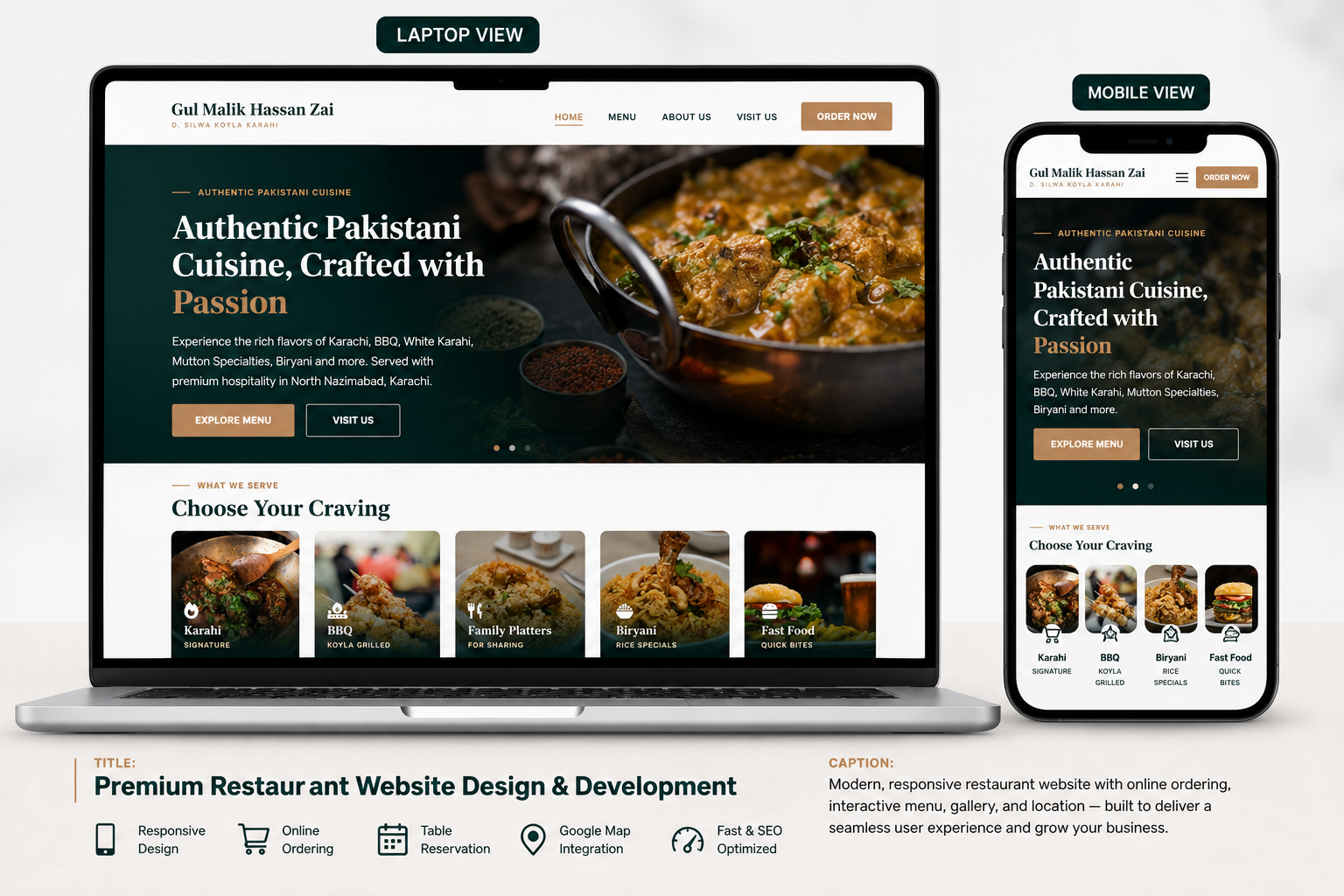
The Restaurant Website Design and Development project is a complete website solution developed for restaurants, cafes, food businesses, and dining establishments looking to build a strong online presence and attract more customers. The website is designed to showcase the restaurant brand, menu, food items, services, location, contact information, and online ordering options through a professional and responsive interface. The development focuses on creating an easy-to-use experience across desktop, tablet, and mobile devices while providing customers with quick access to important restaurant information.
Key Features- Responsive Restaurant Website Design
- Interactive Digital Menu
- Food Categories and Menu Items
- Online Food Ordering
- Table Reservation System
- Restaurant Contact Information
- Google Maps Integration
- Location and Directions
- Mobile-Friendly Design
- SEO-Friendly Website Structure
- Social Media Integration
- Customer-Friendly Navigation
- Restaurant Gallery
- Food Item Details
- Special Offers and Promotions
- Contact and Inquiry Forms
- Fast and User-Friendly Interface
- Cross-Device Compatibility
- Website Content Management
- Online Restaurant Marketing Support
The website is developed specifically for restaurant businesses that want to present their brand professionally online. Restaurant website development includes structured pages for the home section, menu, about the restaurant, services, gallery, contact information, location, reservations, and online ordering. The website structure can be customized according to the restaurant's branding, menu, food categories, business requirements, and target customers. A properly developed restaurant website gives customers an easy way to discover the restaurant, explore available dishes, check the location, and contact the business.
Interactive Restaurant MenuAn interactive menu is one of the most important features of the website. Customers can browse different food categories and view available dishes along with descriptions, prices, images, and other relevant information. The online restaurant menu can be organized into categories such as burgers, pizza, chicken, sandwiches, pasta, desserts, beverages, and other items depending on the restaurant. A digital menu also makes it easier for restaurant management to update food items, prices, categories, and special offers.
Online Food OrderingThe website can include online food ordering functionality that allows customers to select food items and place orders directly through the website. Customers can browse the menu, select products, add items to their cart, review their order, and proceed through the checkout process. Restaurant ordering software can also be connected with billing, inventory, kitchen management, and order processing systems to create a complete restaurant management workflow.
Table ReservationThe table reservation system provides customers with a convenient way to request or book a table before visiting the restaurant. Reservation functionality can include date selection, time selection, number of guests, customer information, and reservation requests. This feature can help restaurants manage bookings more efficiently while giving customers a simple way to plan their visit.
Mobile-Friendly Restaurant WebsiteA large number of customers access restaurant websites through smartphones, which makes mobile-friendly website development an important part of the project. The website layout is optimized for different screen sizes so customers can browse the menu, view food images, make reservations, find the restaurant location, and place orders comfortably from mobile devices. Responsive website design and development provides a consistent experience across smartphones, tablets, laptops, and desktop computers.
Google Maps IntegrationGoogle Maps integration allows customers to easily find the restaurant location and get directions. The map can be displayed directly on the contact or location section of the website, helping customers identify the restaurant and plan their route. Location integration is especially useful for restaurants that want to attract local customers searching for nearby dining options.
SEO for Restaurant WebsiteThe website is developed with SEO in mind to help improve search engine visibility. SEO-friendly page structures, headings, content, keywords, responsive design, optimized navigation, metadata, internal linking, and other technical elements can help search engines understand the website. Restaurant-related keywords can be incorporated naturally into website content to target searches for restaurants, food ordering, restaurant menus, table reservations, and related services.
Restaurant BrandingThe website provides a dedicated digital platform for presenting the restaurant's brand. Colors, typography, images, menu presentation, banners, sections, and overall UI/UX can be designed according to the restaurant's identity. Professional restaurant website design helps create a consistent brand experience and gives potential customers a better understanding of the restaurant before they visit or place an order.
Restaurant GalleryA dedicated gallery section can showcase food items, restaurant interiors, special events, customer experiences, and other visual content. High-quality food and restaurant images can help attract customers and make the website more engaging. The gallery can also be updated as the restaurant introduces new dishes, promotions, events, or seasonal menus.
Restaurant Kiosk Software IntegrationThe website can also work alongside restaurant kiosk software and self-service kiosk software for restaurants that want to provide customers with multiple ordering options. A custom kiosk software solution can allow customers to place orders through touchscreen devices while the website can provide online ordering for customers outside the restaurant. Both systems can potentially connect with billing, inventory, menu, and kitchen management functionality.
Billing and Inventory IntegrationRestaurant operations can be further improved by integrating the website with billing software and inventory management software. Billing software can manage customer orders, invoices, payments, discounts, and transaction records, while inventory software can help manage food items, ingredients, stock levels, purchases, and inventory movements. Connecting these systems can provide restaurants with a more centralized digital management solution.
Custom Web Application DevelopmentThe project can be expanded from a restaurant website into a complete custom web application according to business requirements. Additional features can include online ordering, customer accounts, restaurant management, order tracking, kitchen management, delivery management, table management, inventory, billing, reports, promotions, and administrative dashboards. Web application development allows restaurant businesses to create software that matches their specific operational workflow.
Domain and HostingThe complete website can be deployed using a professional domain and hosting solution. A suitable domain gives the restaurant a recognizable online address, while reliable hosting provides the server environment required to run the website and its database. Domain registration, web hosting, SSL, deployment, backups, maintenance, and technical support can be included as part of a complete website development service.
My Role in the ProjectI developed the Restaurant Website Design and Development project with a focus on responsive design, user experience, restaurant branding, interactive menu presentation, table reservations, Google Maps integration, SEO-friendly structure, and online ordering functionality. The project demonstrates experience in restaurant website development, website design, web application development, custom software development, restaurant ordering software, billing software, inventory software, kiosk software, SEO, domain, hosting, and responsive website development.
ConclusionThe Restaurant Website Design and Development solution provides restaurants with a complete digital platform for presenting their brand, menu, services, location, reservations, and online ordering options. With features such as an interactive menu, table reservation, Google Maps, mobile-friendly design, SEO optimization, online ordering, and potential integration with billing software, inventory management software, and restaurant kiosk software, the website can support both customer engagement and restaurant operations while providing a scalable foundation for future software development.